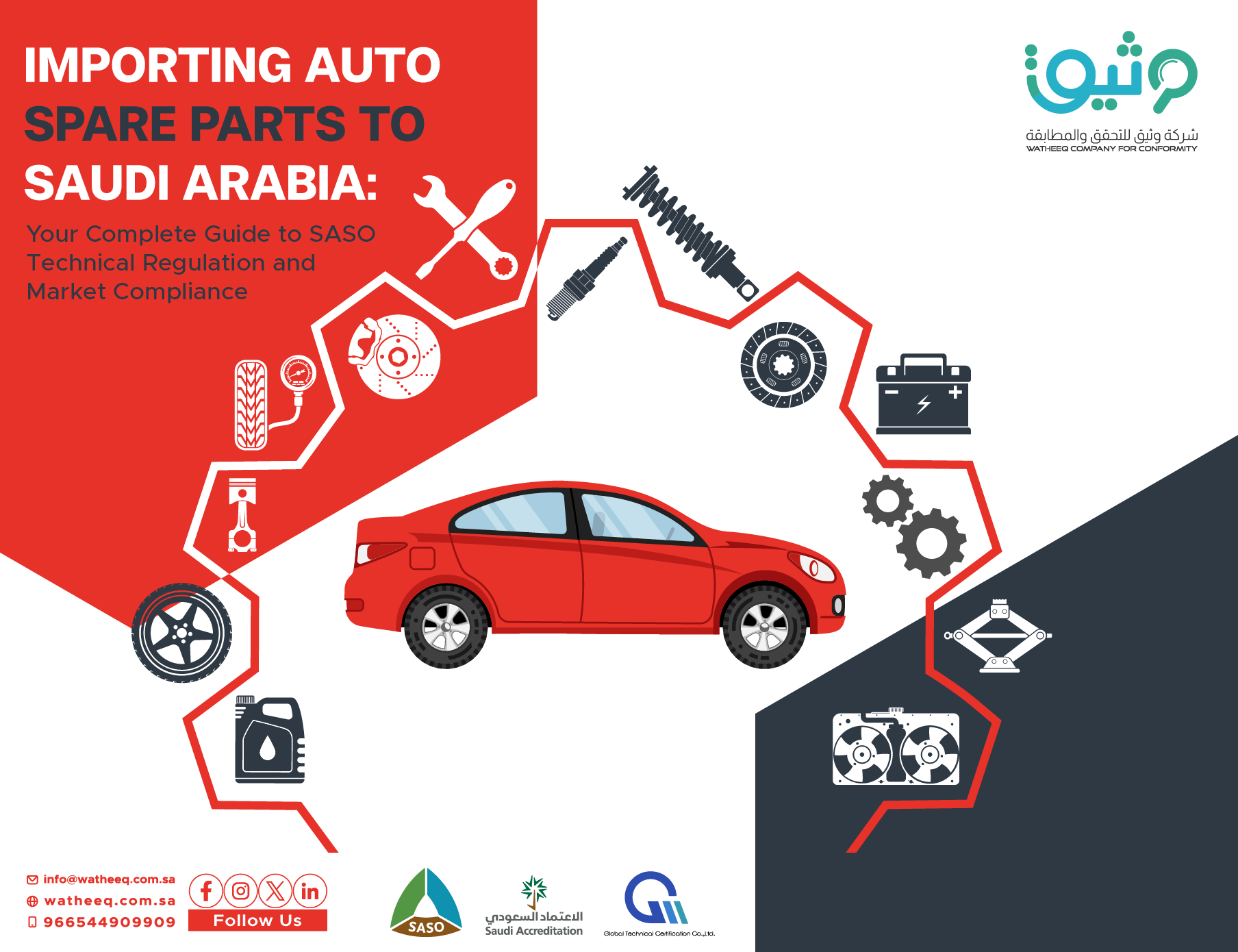
SASO Technical Regulation for Auto Spare Parts: Complete Guide to Importing and Market Compliance in Saudi Arabia

03 Mar 2026 Articles

SASO Technical Regulation for Auto Spare Parts: Complete Guide to Importing and Market Compliance in Saudi Arabia

The SASO Technical Regulation for Auto Spare Parts establishes mandatory safety and quality requirements for all regulated spare parts entering the Saudi market. Whether you are importing auto spare parts to Saudi Arabia for commercial distribution or fleet support, compliance with this regulation is required before customs clearance and market placement.

Saudi Arabia is one of the largest automotive markets in the Middle East, with increasing demand for reliable spare parts that support passenger vehicles, trucks, buses, and logistics fleets. However, only compliant products may legally enter and circulate in the Kingdom.

This guide explains how the regulation impacts importers and how Watheeq Company supports full auto spare parts compliance in KSA.

Why SASO Regulates Auto Spare Parts in Saudi Arabia

Auto spare parts directly affect vehicle safety, operational performance, and environmental impact. Substandard or counterfeit components can result in:

  1. Brake failure
  2. Steering malfunction
  3. Structural weakness
  4. Increased emissions
  5. Road accidents and fatalities

The SASO Technical Regulation for Auto Spare Parts ensures that all regulated parts:

  1. Meet essential safety and performance standards
  2. Are compatible with approved vehicle systems
  3. Do not compromise braking or steering functions
  4. Are properly labeled and traceable
  5. Comply with recognized technical standards

This framework protects consumers, workshops, fleet operators, and the overall transportation sector.

Scope of the SASO Technical Regulation for Auto Spare Parts

The regulation applies to a broad range of components used in:

  1. Passenger vehicles
  2. Commercial trucks
  3. Buses
  4. Industrial and fleet vehicles

Covered categories include:

  1. Brake pads, brake shoes, brake discs
  2. Lighting and signaling devices
  3. Suspension components
  4. Steering system parts
  5. Mirrors and visibility components
  6. Safety-related replacement parts

Both locally manufactured and imported spare parts are subject to identical compliance obligations.

Mandatory Compliance Before Importing Auto Spare Parts to Saudi Arabia

Importing auto spare parts to Saudi Arabia requires full compliance with the applicable technical regulation before shipment arrival.

Compliance must be completed prior to customs clearance. Failure to meet requirements may result in:

  1. Shipment detention at Saudi ports
  2. Customs clearance delays
  3. Re-export or rejection of goods
  4. Financial penalties
  5. Supply chain disruption

Importers are responsible for ensuring conformity assessment is completed before shipping.

SABER Auto Spare Parts Registration Process

The Saudi conformity system is managed through the SABER electronic platform.

All regulated spare parts must undergo SABER auto spare parts registration before importation.

Through SABER, authorities verify:

  1. Product scope under the regulation
  2. Technical documentation
  3. Test report validity
  4. Applicable standards
  5. Conformity assessment route

Only after successful verification can the shipment proceed toward customs clearance.

Key Documentation Required for Compliance

To achieve SASO spare parts certification, importers and manufacturers must prepare comprehensive technical documentation, including:

  1. Manufacturer Commercial Registration (CR)
  2. Product Risk Assessment
  3. Supplier Declaration of Conformity
  4. Product labeling samples and images
  5. User manual (if applicable)
  6. Valid test report from an accredited laboratory
  7. TS16949 certificate

Depending on product risk level, additional conformity assessment auto parts Saudi procedures such as factory audits may apply.

Incomplete documentation is one of the most common causes of delay.

Importance of Correct Product Classification

Proper product classification is essential in SABER registration.

Each spare part category may have:

  1. Different technical standards
  2. Specific testing requirements
  3. Unique conformity routes

Incorrect classification can lead to:

  1. Wrong certification pathway
  2. Rejected conformity review
  3. Customs rejection
  4. Additional reprocessing costs

Working with a specialized conformity body reduces classification errors significantly.

Benefits of Auto Spare Parts Compliance in KSA

Meeting the SASO Technical Regulation for Auto Spare Parts provides strategic advantages:

  1. Faster customs clearance
  2. Reduced shipment risk
  3. Increased customer trust
  4. Regulatory credibility
  5. Protection against penalties
  6. Stronger distributor partnerships

Compliance is not only a regulatory obligation — it is a competitive advantage.

Common Challenges Faced by Importers

Importers often encounter:

  1. Misunderstanding of product scope
  2. Expired or incomplete test reports
  3. Incorrect labeling format
  4. Inaccurate HS code selection
  5. Delays in SABER processing
  6. Inconsistent technical documentation

Addressing these issues early prevents costly shipment disruptions.

How Watheeq Company Supports Auto Spare Parts Importers

Watheeq Company provides complete support for auto spare parts compliance in KSA.

Our services include:

  1. Identifying applicable SASO technical requirements
  2. Verifying regulation scope
  3. Reviewing test reports and documentation
  4. Supporting SABER auto spare parts registration
  5. Coordinating conformity assessment procedures
  6. Ensuring complete regulatory compliance

By working with Watheeq, importers can:

  1. Reduce approval timelines
  2. Avoid costly mistakes
  3. Ensure smooth customs clearance
  4. Protect business reputation

Key Takeaways

  1. The SASO Technical Regulation for Auto Spare Parts is mandatory for importing into Saudi Arabia.
  2. All regulated spare parts must be processed through SABER.
  3. Proper testing, documentation, and classification are essential.
  4. Non-compliant shipments may face delays or rejection.
  5. Watheeq provides full conformity and regulatory support.

Conclusion

The SASO Technical Regulation for Auto Spare Parts plays a vital role in ensuring vehicle safety, environmental protection, and market integrity in Saudi Arabia. Companies importing auto spare parts to Saudi Arabia must complete SABER registration, prepare technical documentation, and follow the correct conformity route before shipment arrival. Failure to comply can result in costly delays and regulatory penalties. However, with proper planning and expert guidance, importers can ensure seamless entry into the Saudi market. Watheeq Company stands as a trusted partner for auto spare parts compliance in KSA, providing professional support throughout the entire conformity assessment process.

Ready to Elevate Your Business?

Watheeq ensures your business meets the highest standards. Need certification, inspection, or guidance? We're here to help

Contact Us