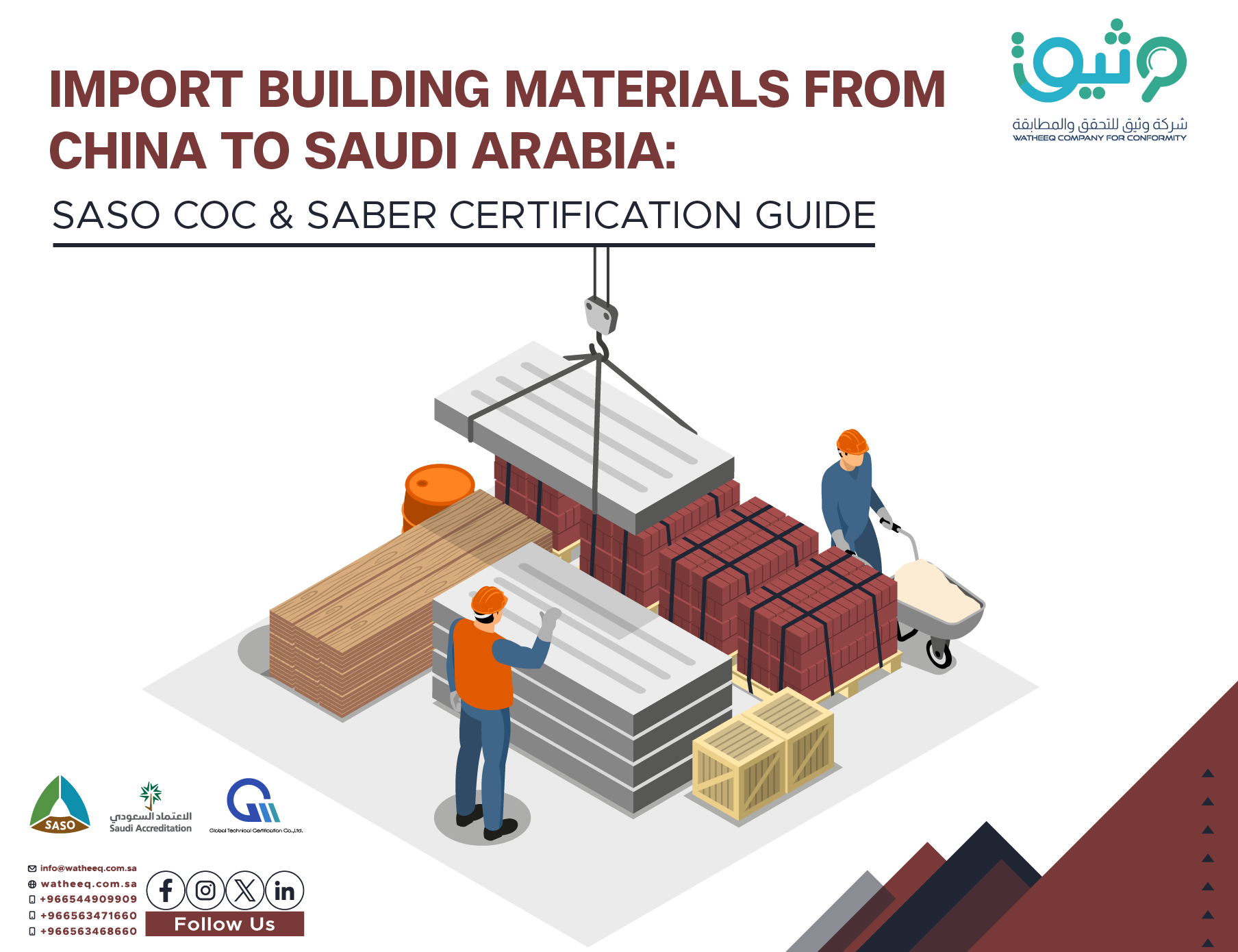
Import Building Materials from China to Saudi Arabia, SASO CoC & SABER Guide

22 Jul 2026 Articles

Import Building Materials from China to Saudi Arabia, SASO CoC & SABER Guide

Import Building Materials from China to Saudi Arabia has become increasingly common as Saudi Arabia continues to expand its construction, infrastructure, and industrial sectors under Vision 2030. China remains one of the world’s largest suppliers of steel, aluminium, and other construction materials, making it the preferred sourcing destination for Saudi importers.

However, importing building materials involves more than selecting quality products and arranging shipment. Before these products can be imported, cleared through Saudi Customs, or placed on the Saudi market, they must comply with the SASO Technical Regulation for Building Materials – Part 1 and obtain the required Certificate of Conformity (CoC) through the SABER Platform.

Failure to comply with Saudi regulations may result in customs delays, shipment rejection, additional storage charges, financial losses, and project delays.

What Is the SASO Technical Regulation for Building Materials – Part 1?

The SASO Technical Regulation for Building Materials – Part 1 establishes the mandatory technical, safety, and quality requirements for metals and metal alloys used in buildings and construction projects throughout Saudi Arabia.

The regulation aims to ensure that construction materials placed on the Saudi market satisfy essential requirements relating to:

  1. Structural safety
  2. Mechanical strength
  3. Durability and long-term performance
  4. Environmental protection
  5. Product quality and reliability

Compliance is mandatory for both locally manufactured and imported products.

Why Is Certification Required for Building Materials Imported from China?

Building materials imported from China must demonstrate compliance with Saudi regulations before entering the Kingdom.

Obtaining a Certificate of Conformity (CoC) confirms that the products satisfy applicable SASO technical requirements and are suitable for use in Saudi construction projects.

Certification helps businesses:

  1. Ensure product safety and quality
  2. Comply with Saudi regulations
  3. Facilitate customs clearance
  4. Avoid shipment rejection
  5. Prevent costly project delays
  6. Improve customer confidence

Building Materials Covered Under Part 1

The regulation covers a wide range of metals and construction products, including:

  1. Reinforcing steel bars (Rebar)
  2. Structural steel sections
  3. Steel beams and profiles
  4. Steel sheets and plates
  5. Steel pipes and tubes
  6. Stainless steel products
  7. Aluminium sections and profiles
  8. Aluminium sheets and plates
  9. Steel wire and welded mesh
  10. Iron and alloy construction products

These products are commonly imported from China for residential, commercial, industrial, and infrastructure projects across Saudi Arabia.

Certificate of Conformity (CoC) for Building Materials

A Certificate of Conformity (CoC) verifies that building materials comply with the applicable Saudi technical regulations.

For regulated products, two certificates are generally required:

  1. Product Certificate of Conformity (PCoC) – issued for the approved product model after successful conformity assessment.
  2. Shipment Certificate of Conformity (SCoC) – issued for every shipment before customs clearance.

For certain high-risk construction products, obtaining the Saudi Quality Mark (SQM) or an equivalent mandatory certification may also be required.

SABER Certification Process to Import Building Materials

All conformity assessment procedures are completed through the SABER Platform, Saudi Arabia’s official electronic system for product registration and certification.

The certification process generally includes:

  1. Product registration in SABER
  2. Submission of technical documentation
  3. Technical review by an approved Conformity Assessment Body (Watheeq)
  4. Product conformity assessment
  5. Issuance of the Product Certificate of Conformity (PCoC)
  6. Issuance of the Shipment Certificate of Conformity (SCoC)

Without successful certification, regulated products cannot be cleared through Saudi Customs or legally sold in the Kingdom.

Documents Required for Certificate of Conformity (CoC)

Manufacturers and importers should prepare the following documents:

  1. Risk Assessment
  2. Test reports from accredited laboratories
  3. Product photographs
  4. Product labels and marking information
  5. Manufacturer details
  6. Factory audit reports (where applicable)

Providing complete and accurate documentation significantly speeds up the certification process and minimizes approval delays.

Product Labelling Requirements to Import Building Materials

Building materials covered by the regulation must include appropriate product identification, including:

  1. Product name
  2. Manufacturer or brand name
  3. Country of origin
  4. Product model
  5. Installation instructions or safety warnings (where applicable)
  6. Arabic labelling or bilingual (Arabic/English) information when required

Proper labelling helps ensure compliance with Saudi market requirements and facilitates product identification throughout the supply chain.

Consequences of Non-Compliance

Failure to comply with the SASO Technical Regulation for Building Materials – Part 1 may result in:

  1. Shipment rejection at Saudi Customs
  2. Customs clearance delays
  3. Restricted market access
  4. Additional storage costs
  5. Financial losses
  6. Project delays
  7. Damage to business reputation

Early compliance helps companies avoid unnecessary costs while ensuring uninterrupted project execution.

How Watheeq Supports to Import Building Materials

Watheeq is the legal representative of Global Technical Certification Co., Ltd. (GTC). We provide competitive certification solutions, with all certificates issued through GTC.

Our comprehensive services include:

  1. Technical document review
  2. Product compliance verification
  3. SABER registration support
  4. Factory audit coordination
  5. Issuance of Product Certificates of Conformity (PCoC)
  6. Issuance of Shipment Certificates of Conformity (SCoC)

With Watheeq, manufacturers and importers can simplify the certification process and ensure full compliance before shipment.

Key Takeaways

  1. Building materials imported from China must comply with the SASO Technical Regulation for Building Materials – Part 1.
  2. A Certificate of Conformity (CoC) is mandatory before products can enter the Saudi market.
  3. Certification is completed through the SABER Platform.
  4. Certain construction products may also require the Saudi Quality Mark (SQM).
  5. Early compliance helps prevent shipment rejection, customs delays, and additional costs.
  6. Working with an experienced Conformity Assessment Body simplifies the certification process.

Conclusion

Importing building materials from China to Saudi Arabia requires more than sourcing quality products—it requires full compliance with Saudi regulatory requirements. By obtaining the appropriate Certificate of Conformity (CoC) and completing the SABER certification process, manufacturers and importers can ensure their products meet Saudi safety, quality, and performance standards.

Partnering with an experienced Conformity Assessment Body like Watheeq helps streamline certification, reduce compliance risks, and ensure smooth customs clearance, enabling businesses to confidently supply building materials to one of the fastest-growing construction markets in the world.

Ready to Elevate Your Business?

Watheeq ensures your business meets the highest standards. Need certification, inspection, or guidance? We're here to help

Contact Us