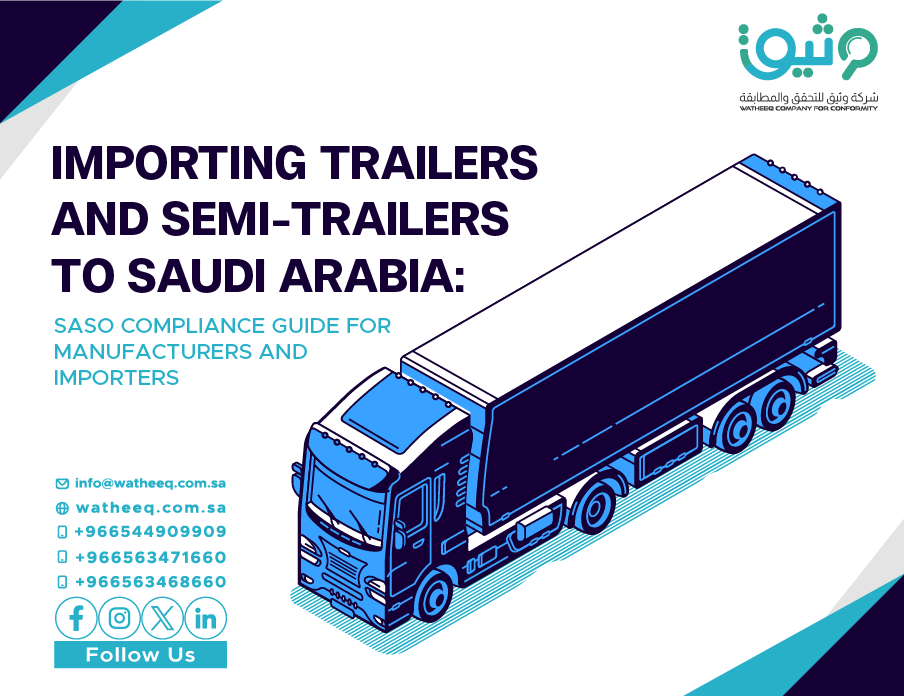
Importing trailers and semi-trailers to Saudi Arabia: Essential Compliance Guide

12 Mar 2026 Articles

Importing trailers and semi-trailers to Saudi Arabia: Essential Compliance Guide

Importing trailers and semi-trailers to Saudi Arabia is a regulated process that requires strict compliance with national technical requirements issued by the Saudi Standards, Metrology and Quality Organization (SASO).

Whether you are a manufacturer, supplier, or importer planning to place trailers and semi-trailers on the Saudi market, understanding certification and production-line accreditation requirements is essential. Failure to comply may result in shipment delays, rejection of products, or regulatory non-conformity issues.

This guide explains how trailers and semi-trailers are approved in Saudi Arabia under the SASO Technical Regulation for Trailers and Semi-Trailers and what manufacturers and suppliers must prepare before entering the market.

Why Trailers and Semi-Trailers Are Regulated in Saudi Arabia

Trailers and semi-trailers are classified as high-risk road transport equipment. Any failure in braking systems, structural components, lighting systems, or rear protection devices can lead to severe road accidents and serious consequences.

To minimize these risks, Saudi Arabia enforces strict safety and quality requirements to ensure that all trailers and semi-trailers placed on the market meet defined standards for:

  1. Road safety
  2. Structural integrity
  3. Operational reliability
  4. Durability under heavy-duty conditions

Compliance with these requirements is mandatory before trailers or semi-trailers can be supplied, registered, or operated within the Kingdom.

Production Line Accreditation – Not Only Product Testing

One of the most important aspects of the SASO Technical Regulation for Trailers and Semi-Trailers is that certification does not apply only to a single tested unit.

Instead, the required certificate is issued to accredit the manufacturer’s production line, confirming that the factory has the capability to consistently produce trailers and semi-trailers that comply with regulatory requirements.

This evaluation typically includes assessment of:

  1. Production system and manufacturing processes
  2. Quality management procedures
  3. Inspection and testing controls
  4. Technical competence of the manufacturer

By evaluating the factory’s production capability, SASO ensures compliance is maintained continuously rather than verified only on individual shipments.

Who Must Comply with the Technical Regulation?

The regulation applies to all parties involved in supplying trailers or semi-trailers to the Saudi market, including:

  1. Manufacturers producing trailers intended for Saudi Arabia
  2. Importers placing trailers on the Saudi market
  3. Brand owners and suppliers responsible for product conformity

The party responsible for introducing the product into the Saudi market remains legally accountable for ensuring full compliance with all applicable requirements.

Key Technical Requirements for Importing trailers and semi-trailers

To obtain conformity approval and production-line accreditation, manufacturers must prepare several mandatory technical and quality documents.

Below are the main requirements specified under the regulation.

1. Certificate of Conformity for Rear Protection Barriers

Manufacturers must provide a valid certificate of conformity for truck and trailer rear protection devices (barriers).

These safety components are designed to prevent underride accidents in which smaller vehicles slide beneath trailers during collisions.

The certificate must demonstrate compliance with structural and performance requirements referenced in the technical regulation.

2. Final Product Test Reports from an Accredited Laboratory

Manufacturers or suppliers must submit test reports on the completed trailer or semi-trailer.

These reports must:

  1. Follow the referenced international or regional standards specified in the regulation
  2. Be issued by laboratories accredited under the ISO/IEC 17025 standard

The reports confirm compliance with essential safety requirements such as:

  1. Braking system performance
  2. Coupling systems
  3. Tire compatibility and safety requirements

3. Monitoring and Testing Reports for Raw Materials

Quality control at the material level is another key regulatory requirement.

Manufacturers must maintain documentation such as:

  1. Raw material monitoring reports
  2. Material testing records
  3. Supplier verification documents

This ensures that structural components, steel materials, and key assemblies used in manufacturing meet required specifications before entering production.

4. Inspection and Testing During the Manufacturing Process

In-process quality control plays a critical role in ensuring continuous compliance.

Manufacturers must provide records including:

  1. Fabrication inspection results
  2. Welding inspection reports
  3. Dimensional and visual inspection records
  4. Functional testing during production stages

These documents demonstrate that quality and safety controls are maintained throughout the manufacturing cycle.

5. Completion of Required SASO Forms and Declarations

The certification process also requires completion of several official documents, including:

  1. Conformity declaration
  2. Production line accreditation application
  3. Technical data sheets for certified trailer models

Accurate preparation of these documents is essential to prevent delays or rejection during evaluation.

How Watheeq Company Supports Trailer Compliance in Saudi Arabia

Watheeq Company supports manufacturers and importers throughout the compliance process by:

  1. Reviewing technical documentation against SASO regulatory requirements
  2. Verifying laboratory test reports and accreditation status
  3. Assessing manufacturing inspection and quality records
  4. Supporting preparation of conformity declarations and official forms
  5. Coordinating the production-line accreditation certification process

Our team ensures that both manufacturing systems and final products meet Saudi regulatory expectations before submission.

Key Takeaways

  1. Trailers and semi-trailers supplied to Saudi Arabia must comply with the SASO Technical Regulation for Trailers and Semi-Trailers.
  2. Certification is issued to accredit the production line, not only a single product.
  3. Mandatory documentation includes barrier conformity certificates, laboratory test reports, raw material monitoring records, and in-process inspection results.
  4. Proper preparation of technical and manufacturing documentation is critical for successful approval.

Conclusion

Importing trailers and semi-trailers to Saudi Arabia requires careful preparation and full compliance with the technical requirements established by the Saudi Standards, Metrology and Quality Organization. Unlike many other regulated products, the certification process focuses on production line accreditation rather than only product testing, ensuring that manufacturers can consistently produce compliant trailers and semi-trailers. By preparing the required documentation—such as laboratory test reports, barrier conformity certificates, raw material monitoring records, and in-process inspection results—manufacturers and importers can significantly reduce approval delays and regulatory risks. Working with experienced compliance partners can further simplify the process and ensure smooth access to the Saudi market.

Ready to Elevate Your Business?

Watheeq ensures your business meets the highest standards. Need certification, inspection, or guidance? We're here to help

Contact Us